K.ai is Klivvr's in-app assistant, the first AI assistant natively integrated into a fintech product in the MENA region. I wrote its knowledge base and tone framework from zero, and I still own the content behind what it resolves, what it escalates, and what it can't answer yet.
K.ai launched with zero prior content. No fallback copy, no tone precedent, no answer bank. It had to sound like Klivvr in two languages, know the product in detail across 12 domains, and be honest about its scope: it's read-only by design, so copy had to make that boundary feel like a natural part of what the assistant does, not a shortfall. Since launch, the challenge has shifted to keeping resolution quality high as the knowledge base, and the conversation volume, keeps growing.
Arabic dialect strategy
Egyptian colloquial for questions, since that's how users actually ask them, and Modern Standard Arabic for regulatory and financial answers, where precision matters more than warmth.
Read-only by design
K.ai can surface account information but can't take action. The copy had to frame that boundary as a natural part of how the assistant works, not a limitation.
Naming consistency
Locked down consistent product naming and financial terminology across both languages, so nothing drifted between screens, knowledge base entries, or teams. That includes the one accepted Arabic term for "credit limit," set in the Credit & Loans work.
Structure over content
Built the knowledge base as six columns per entry: label, possible questions, and response, each in English and Arabic. That structure meant new domains could be added without redesigning the system.
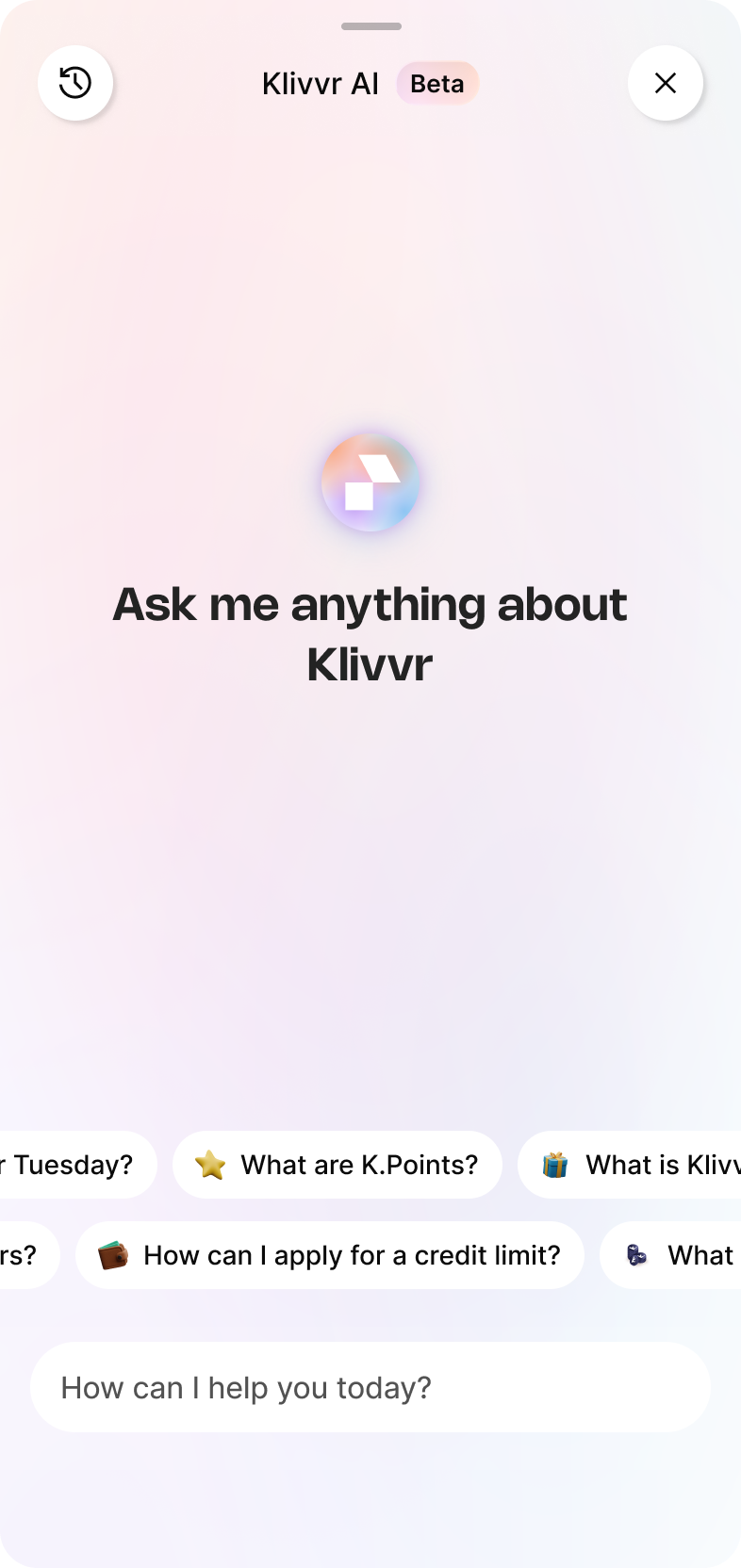
The engine behind every answer
The knowledge base is the actual engine behind K.ai's resolution rate. Every answer it gives without escalating to a human traces back to an entry I wrote or maintain. It's currently 272 entries across 12 product domains, each structured the same way: a label, the range of ways a user might ask the question, and a response written in both English and Egyptian or MSA Arabic depending on context.
This isn't a one-time deliverable. It's a living system I keep expanding as new features ship and as gaps in coverage show up in production data. Every new entry gets flagged for native-speaker Arabic review before it goes live, the same standing convention used across all Klivvr product copy.
How K.ai performs in production
Resolves roughly 92% without a human, a rate that's held steady even as volume climbs. Most conversations wrap up in just a few turns.
Coverage is the number I'd lead with. It's a direct line from "wrote more knowledge base entries" to "more questions get answered without a human," which is the core value proposition of the whole assistant.
This project taught me that AI product content is infrastructure, not copy. The knowledge base isn't just writing. It's a system that has to be accurate, maintainable, and scalable, and one I can now point to with real usage data instead of just describing the intent behind it. Watching coverage and resolution rate move in response to content decisions has changed how I think about UX writing generally. It's not just "does this read well," it's "does this measurably reduce the number of people who need a human."