Every message a fintech app sends carries meaning: a due date, a decline, a discount. Klivvr's Language & Communication Guidelines is the document I wrote and maintain to make sure all of those messages sound like they came from the same place, clear, warm, and useful, whether the news is good or not.
Human, not corporate
I defined four pillars that describe how Klivvr talks: Human & Conversational, Simple & Clear, Storytelling & Slice of Life, and Empowering & Engaging. Every pillar comes with a short rationale and real examples, so any writer or designer on the team can apply them without guessing.
Human & Conversational
We talk to people, not at them. That means building a relationship, not a transaction.
"Want us to deliver your cards?"
Simple & Clear
No jargon. If a term needs a finance degree to understand, we don't use it.
"Switch between credit and debit with a tap"
Storytelling & Slice of Life
We show our values through relatable, real-world moments, not abstractions.
"75% of our users achieve their goals faster with automations"
Empowering & Engaging
We give users the tools and confidence to act, not just information to read.
"Manage all your family expenses from one place"
The same voice, four different moods
Tone is the emotional layer on top of our voice, and it shifts with context. I mapped out exactly when to use each: Informative for products and updates, Encouraging to nudge a user or celebrate a milestone, Reassuring when something's gone wrong, and Urgent when the user needs to act now. Writers don't have to decide this from scratch on every screen. The guideline decides it for them.
Active voice, as a default
Active voice reads faster, feels more direct, and puts the user in charge of the action, all things that matter when someone's trying to send money or fix an error mid-task. I documented the standard, plus the two specific cases where passive voice is the right call: downplaying the user's role in a failure, or focusing on a result rather than an action.
Enter your password
Send money
We've updated your profile
Your password should be entered
Money can be sent
Your profile has been updated
One name per concept, everywhere
Fintech products drown in synonyms. Is it a loan, a line of credit, or "lending"? I keep a shared internal glossary that locks one accepted term per concept in both English and Arabic, so no writer, designer, or support agent has to guess which word is ours.
Guide, don't lecture
I set a simple rule for support content: start with the user's actual question, answer directly, skip the jargon, and end with clarity instead of a policy statement.
Do I need approval for a credit limit?
Yes, but it's super simple. Apply directly from the app, and we'll let you know instantly if you qualify.
Eligibility Requirement
Customers must undergo a financial assessment to determine eligibility.
Sized to actually be read
A push notification is a two-second moment, so I documented hard limits per platform (iOS: 50-character titles, 178-character bodies; Android: 65 / 240) and a tighter, device-safe guideline underneath that: 20-character titles, 130-character bodies, so the message never gets cut off with a "read more."
Big purchase? We've got your back. Pay later, on your terms.
Your payment is overdue. Pay before July 3 to avoid late fees.
Instant financing options available for eligible customers.
Your loan payment is late. Pay now or incur fees.
Dates, durations, and money, standardized once
Dates, durations, ordinal numbers, and monetary amounts are each standardized to one format across the app, so a screen never feels like it was stitched together by five different writers.
A reference the whole product runs on
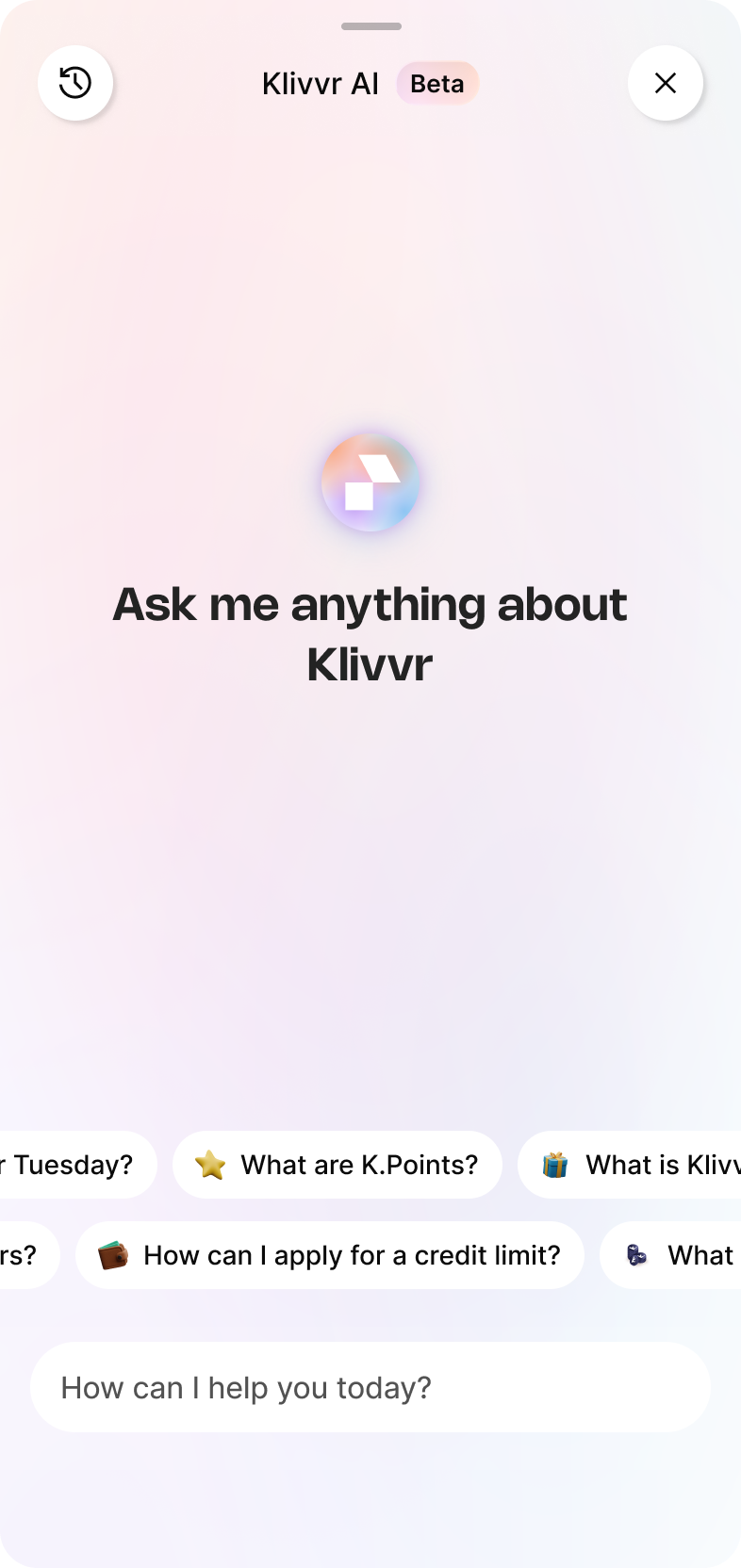
The guidelines are Klivvr's single source of truth for tone, terminology, and formatting. Writers and designers use them, and we referenced them when we built K.ai, Klivvr's in-app AI assistant, so that even our AI answers in the same voice as the rest of the product.
Results
- One living reference for tone, terminology, and formatting, so there's no more re-deciding voice decisions screen by screen.
- A shared vocabulary that keeps English and Arabic content consistent across the whole app.
- A structural foundation for K.ai, so Klivvr's AI assistant answers in the brand's own voice.
- Faster onboarding for new writers and designers, who now inherit a rulebook instead of tribal knowledge.